
 UPDATE! October 1st, 2023: This version of the website will no longer receive updates. Please transition to the new website for the best experience.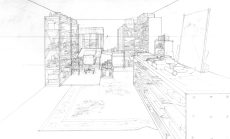
In week one, Gary Meyer introduces essential perspective concepts, starting with an overview of one-point perspective. You will learn how to construct an interior space, utilizing a plan view to establish accurate proportions before projecting your scene into perspective, using a horizon line, vanishing point, and measuring points to guide your construction. Then, you’ll refine your drawing by adding furniture, architectural elements, and freehand details to create an engaging and believable environment. By the end of this lesson, you’ll have a strong understanding of how to build believable one-point perspective drawings, setting the foundation for more complex illustrations.
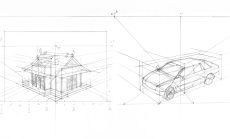
In week two, Gary Meyer will teach you the fundamentals of two-point perspective, focusing on station points, measuring points, and measuring lines to construct buildings and vehicles from various angles. You’ll begin by dividing planes into equal units, then draw both simple and advanced gabled-roof houses with precise, measured proportions. Finally, you’ll construct a car, breaking down its complex forms into logical, manageable steps. By the end of this lesson, you’ll have the skills to confidently measure and draw two-point objects to scale.
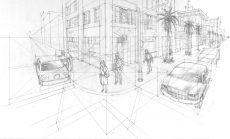
In week three, you’ll dive into an advanced use of two-point perspective by designing a bustling street corner with buildings, vehicles, and figures. Starting with a loose layout, you’ll establish a clear horizon line and vanishing points before constructing overlapping buildings with varied architectural elements. You’ll integrate figures and vehicles to reinforce depth and scale while refining compositional elements to lead the viewer’s eye through the scene. This lesson will help you develop confidence in planning complex cityscapes while maintaining accurate perspective.
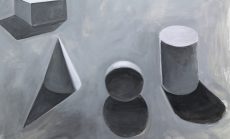
In week four, Gary Meyer introduces light logic and rendering from imagination through a monochrome acrylic study of geometric forms. You’ll start by sketching a box, sphere, cone, and cylinder under a single light source, carefully plotting their cast shadows. Gary will demonstrate a structured painting process, beginning with a mid-tone background and gradually building up core shadows, highlights, and reflected light to create smooth transitions between planes. By the end of this lesson, you’ll have a solid foundation in acrylic painting techniques and a clear approach to creating realistic lighting in your illustrations.
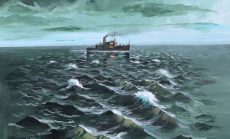
In week five, you will paint a moody seascape illustration from imagination. Gary Meyer will guide you in blocking in the sky and water with gradients, then teach you how to construct waves using the pyramid-form method, applying planes and light logic to create realistic reflections. By layering foam patterns, transparent and opaque passages, and adding a boat, you’ll have the skills to paint a dynamic, believable ocean scene with depth and movement.
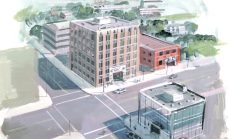
In week six, you will build on your perspective and painting skills by illustrating a sunlit urban street scene. You’ll start with a two-point perspective sketch, then block in the composition using a structured, procedural approach. Gary Meyer will demonstrate how to establish warm sunlight and cool shadow relationships, integrate reflective windows, and refine architectural and environmental details. By the end of this lesson, you’ll know how to balance solid perspective with light, shadow, and detail to create a believable cityscape from imagination.
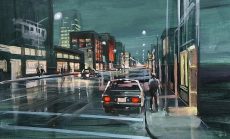
In week seven, you’ll explore the atmospheric effects of a rainy nighttime cityscape, focusing on perspective, light reflections, and depth. Gary Meyer will guide you through blocking in a dark, cool-toned background, then painting silhouetted buildings, streetlights, and glowing windows, using light falloff to create a convincing night atmosphere. You’ll add wet road surfaces, vehicles, and figures, carefully tracking reflections and maintaining accurate perspective. By the end of this lesson, you’ll be able to illustrate a moody, believable urban environment with dynamic reflections and atmospheric depth.
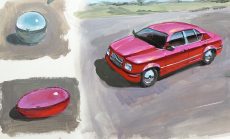
In week eight, you will learn how to depict realistic reflections and material properties. Gary Meyer will begin with a diagram of how reflections behave on curved surfaces, followed by an analysis of reflections on chrome and painted metallic spheres and round forms. You’ll then apply these principles to a reflective car, learning to integrate reflections with the surrounding environment. By the end of this lesson, you’ll be able to paint convincing reflective surfaces, balancing clarity and detail for believable illustrations.
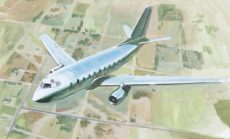
In week 9, you’ll create a reflective airplane illustration from a bird’s-eye view, focusing on capturing realistic form, reflections, and atmospheric perspective. Gary Meyer will demonstrate how to construct the airplane and environment with accurate perspective, ensuring a strong compositional foundation. You’ll then learn how to paint reflective surfaces, using sky and ground reflections to enhance depth and realism, while effectively reflecting objects into one another. By the end of this lesson, you’ll be able to integrate reflective objects seamlessly into dynamic, believable environments.
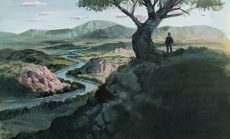
In week ten, Gary Meyer will guide you through painting a mountain landscape from imagination, focusing on composition, value grouping, color harmony, and atmospheric depth. You’ll begin with a thumbnail sketch to plan your scene, then block in the sky and build distinct foreground, middle ground, and background layers with elements like distant mountains, rivers, trees, and rolling hills. Gary will demonstrate how to integrate these elements cohesively using a balance of soft and hard edges to create atmospheric perspective. By the end of this lesson, you’ll be able to design immersive natural environments from imagination with clarity and confidence.
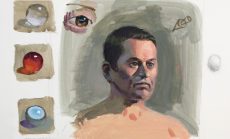
In week eleven, you’ll create a portrait illustration from imagination, focusing on form, light, and color temperature. Gary Meyer will demonstrate how to start with a proportional pencil lay-in, followed by a structured, procedural approach to painting. You’ll establish flat light and shadow masses, then gradually refine subtle halftones, shadows, and key facial features. By incorporating cool skylight into shadow areas and warm sunlight into highlights, you’ll achieve a natural, dimensional effect. By the end of this lesson, you’ll have a solid understanding of how to apply light logic and color harmony to create expressive, imaginative portraits.
Common Questions
This course is appropriate for intermediate and advanced levels.
This course includes downloadable assignment PDFs, that help you practice the materials taught by instructor Gary Meyer. Keeping up with these assignments will maximize your learning outcomes.
A material PDF list is linked in each lesson under the description. Please check the file to see what you need to prepare.
Most New Masters Academy courses are designed to be done traditionally or digitally. Software changes constantly, but the fundamentals stay the same. It will be up to you to translate the information that you are learning to your software of choice.