
 UPDATE! October 1st, 2023: This version of the website will no longer receive updates. Please transition to the new website for the best experience.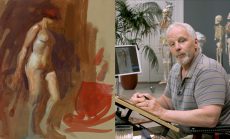
In week one, Steve Huston introduces the sketchbook as a place to generate painting ideas. He discusses how artists can learn from master drawings, paying attention to gesture, structure, and design, and shows how this kind of study can inform your own creative choices.
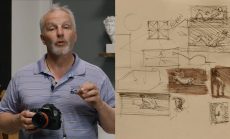
In week two, you will learn how an initial idea can be developed into a working plan for a painting. Steve Huston demonstrates how quick thumbnails and sketchbook concepts help clarify composition and mood before moving into the studio.
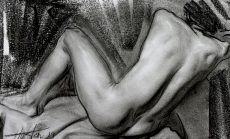
In week three, Steve Huston shifts focus to charcoal as a way of studying value and structure. He demonstrates how tonal design can create a strong sense of form, while showing how atmosphere can be built into a drawing.
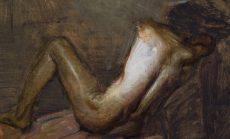
In week four, Steve Huston moves from preparatory studies to a finished figure painting in oil. He demonstrates how the ideas developed through sketches and compositional planning carry into the painting, shaping decisions about value, structure, color, and atmosphere.
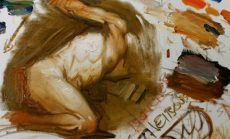
In week five, Steve Huston demonstrates how a figure painting in oil can be brought to resolution in a single session using a full color palette. From the outset, color is handled as part of the painting’s structure, with value, temperature, edges, and surface working together rather than in separate stages.
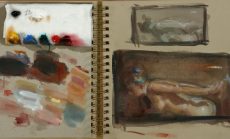
In week six, Steve Huston uses gouache to prepare for the upcoming long-form oil paintings. He demonstrates how a small study can be used to test the figure’s placement, the relationship of background and silhouette, and the balance of color and value.
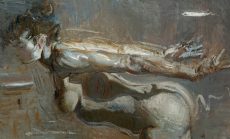
In week seven, Steve Huston begins two long-form figure paintings, one with Amanda and one with Rajiv. He establishes the groundwork by toning the canvas, blocking in the figure, and organizing the major divisions of light and shadow.
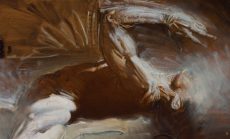
In week eight, Steve Huston continues building the long-form paintings, reinforcing the figure’s structure and refining the relationship between figure and background. He focuses on large forms such as the torso, head, and limbs, while also introducing a range of edges to create rhythm and atmosphere.
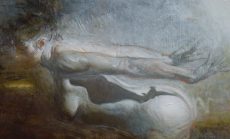
In week nine, Steve Huston begins to expand the palette, layering warm and cool notes across the figure and echoing them in the environment. He demonstrates how color harmonies can unify a painting while gradations and glazes add visual depth.
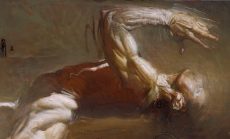
In week ten, Steve Huston begins refining focal areas of the long-form paintings while maintaining energy across the whole composition. He strengthens contrasts, sharpens edges, and enriches select color passages in places he wants to draw the eye, while keeping other areas softer and more atmospheric.
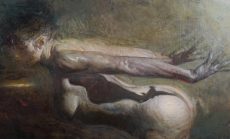
In week eleven, Steve Huston brings both long-form paintings to completion. He demonstrates how to resolve a work with restraint, placing highlights, accents, and edges only where they serve the design.
Common Questions
This course is appropriate for intermediate and advanced levels.
This course includes downloadable assignment PDFs, that help you practice the materials taught by instructor Steve Huston. Keeping up with these assignments will maximize your learning outcomes.
A material PDF list is linked in each lesson under the description. Please check the file to see what you need to prepare.
Most New Masters Academy courses are designed to be done traditionally or digitally. Software changes constantly, but the fundamentals stay the same. It will be up to you to translate the information that you are learning to your software of choice.